
Reading a Nutrition Label
What does a nutrition label tell you, and what does it mean for you?
Jessica Collins
10/9/20255 min read


Nutrition Facts labels are a great way to learn what is going on your plate, and a deeper understanding of how to apply the information can inform your food choices when it comes to reaching nutrient goals.
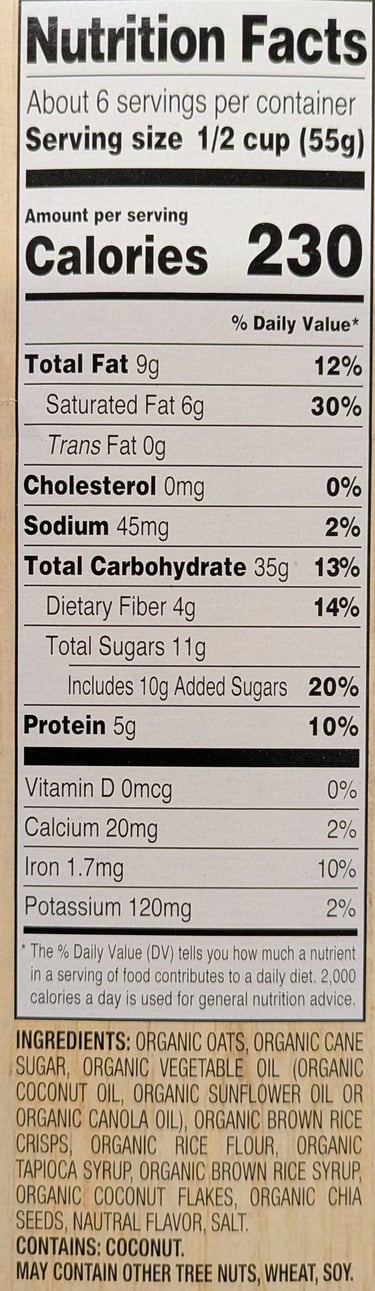
Sample Nutrition Facts
First, this is a sample label from the US and meets USDA requirements for what food manufacturers are required to inform consumers of.
What a serving size is and what it isn't:
At the top, the manufacturer of this food item (this happens to be from a granola type cereal product) has informed you that there is approximately (6) half-cup servings (55g each), or 330g of product within the container. A serving size that is provided by the manufacturer is the sample size that the nutrition facts are based on. The manufacturer is NOT telling you that this is the right amount of this food for you to eat, it's simply a reasonable amount that they can measure and provide the data on. Your portion size will vary depending on how you are using the food to meet your daily goals. Some days, you might use 15g as a topping for yogurt, and other days, you might need 75g to finish off your day (maybe you were super busy and didn't get a chance to eat).
Serving sizes are not standardized in the US. Other countries use different formats (for example, European nutrition facts are standardized to a 100g serving size, no matter how big the food package is).
Recap:
Serving size: the numbers on the nutrition facts label are based on this amount of the food in question
Portion size: how much you actually serve yourself, based on how it fits into your overall personalized daily plan
Pro tip: Food containers are almost always filled by weight in an assembly line type of setting, so using a food scale to portion your food out will be more accurate than using measuring cups when a weight is provided in the serving size section.
Nutrient data:
The next section of the label shows a variety of nutrients and how much is in each serving (in this case, per half-cup or 55g). From a macronutrient perspective, the main information you need to know for meeting your plan is total fat, total carbohydrates, and total protein.
The fats section is further broken down to show you how much of the total fat is saturated or trans-fats, important for some health-related goals like managing heart-healthy diets; the remaining balance of fat will be unsaturated fat grams.
The carbohydrates section is further broken down to show you how much fiber, sugar (and within sugar, how much is 'added sugar'), again, important for some health-related goals - higher fiber goals may be part of a heart-healthy diet, while limiting sugars is usually a high priority for diabetics. Alternately, there are times when a doctor tells you to avoid high-fiber foods for a certain time frame, like the first stage of colonoscopy prep.
Protein is not broken down into protein type, and the only place you may see labeling break this down is on protein supplements where that information is more of a marketing strategy than a labeling requirement.
Percent Daily Value:
On the right hand side, there are percentages. These are based on a standardized 2000 calorie diet, so unless your plan specifically has you on that calorie intake, the percentages may not be particularly helpful for most people. One thing they can do is give you a quick gut-check on whether this is a 'high sugar' food or a 'low fat' food (for example). A good rule of thumb is that values of 20% or higher can be considered "high" in that nutrient, while a value of 5% or less can be considered "low" in that nutrient. So, for this food, if your primary goals are to keep saturated fat and sugar down, you might make a different food choice or eat a smaller portion, while if your main objective is low sodium and you need to fill in some fat/carb gaps in your plan, you might eat a larger portion.
Percent daily value of some vitamins and minerals are also listed in the next section. Some labels might include additional vitamins/minerals, but these 4 are standard on a US food label. Generally speaking, you won't have specific goals for these nutrients unless your doctor has found a reason to provide goals (to limit or to increase them) due to a medical concern, and if you're eating a varied diet and/or taking a daily multivitamin, you're safe ignoring these.
Ingredients List:
The ingredients are listed under the nutrition data. Ingredients are listed in order by weight, in decreasing order. So, by weight, this food has the highest weight of organic oats, then cane sugar, then oil, and so on. This section is important from the perspective of getting a variety of food ingredients in your diet. In many highly processed foods (no matter the variety of flavor and texture), the first few ingredients are the same across many foods, so you can trick yourself into thinking you're eating a wide variety of foods when you're really eating just 3 or 4 main ingredients all the time, prepared in many different ways.
Allergen Disclosure and Cross-Contamination Statement:
Below the ingredients, manufacturers are required to state (even if it's already in the ingredient list) whether a food includes one of the top 9 food allergens (wheat, soy, dairy, eggs, tree nuts, peanuts, fish, shellfish, and sesame), or other common allergens that the manufacturer feels like they need to report on - in our sample label, the manufacturer has specifically listed coconut, even though it's not mandatory to report this allergen.
Some people with food allergies are so sensitive to the ingredients that any trace of the ingredient will cause a reaction, so manufacturers also disclose whether or not the ingredient is prepared on equipment/machinery that is also used for allergen-containing foods OR within the facility, even if equipment is not shared or reset between lots of food (so, even if the food doesn't include it as an ingredient, there could be a trace remaining from a prior food processed on the same line, or allergen-containing dust in the air).
People with food allergies should avoid their allergens entirely, unless under care of an allergist who has provided alternative guidelines.
What are the key takeaways for you and your nutrition plan?
Use the macronutrient grams information to build your meal plan around your macro goals with portion sizes that work for your personalized nutrition goals.
Use the sodium milligrams, and the fiber, saturated fat, sugar grams information to further dial in your meal plan to reach specific health-related goals (generally speaking, choose lower sodium, higher fiber, lower sat fat, and lower sugar options for the bulk of your food intake)
Choose a variety of ingredients so that you get a variety of nutrients
Pay attention to allergen information if you have food allergies or have friends/loved ones with food allergies. It's not necessary to limit these foods unless they cause allergic reactions.
Wellstring Nutrition and Wellness
Resources to keep your healthy lifestyle affordable.
Contact
Support
jessica@wellstringnutrition.com
(434) 222-4177
© 2025. All rights reserved.
This site may contain affiliate links